

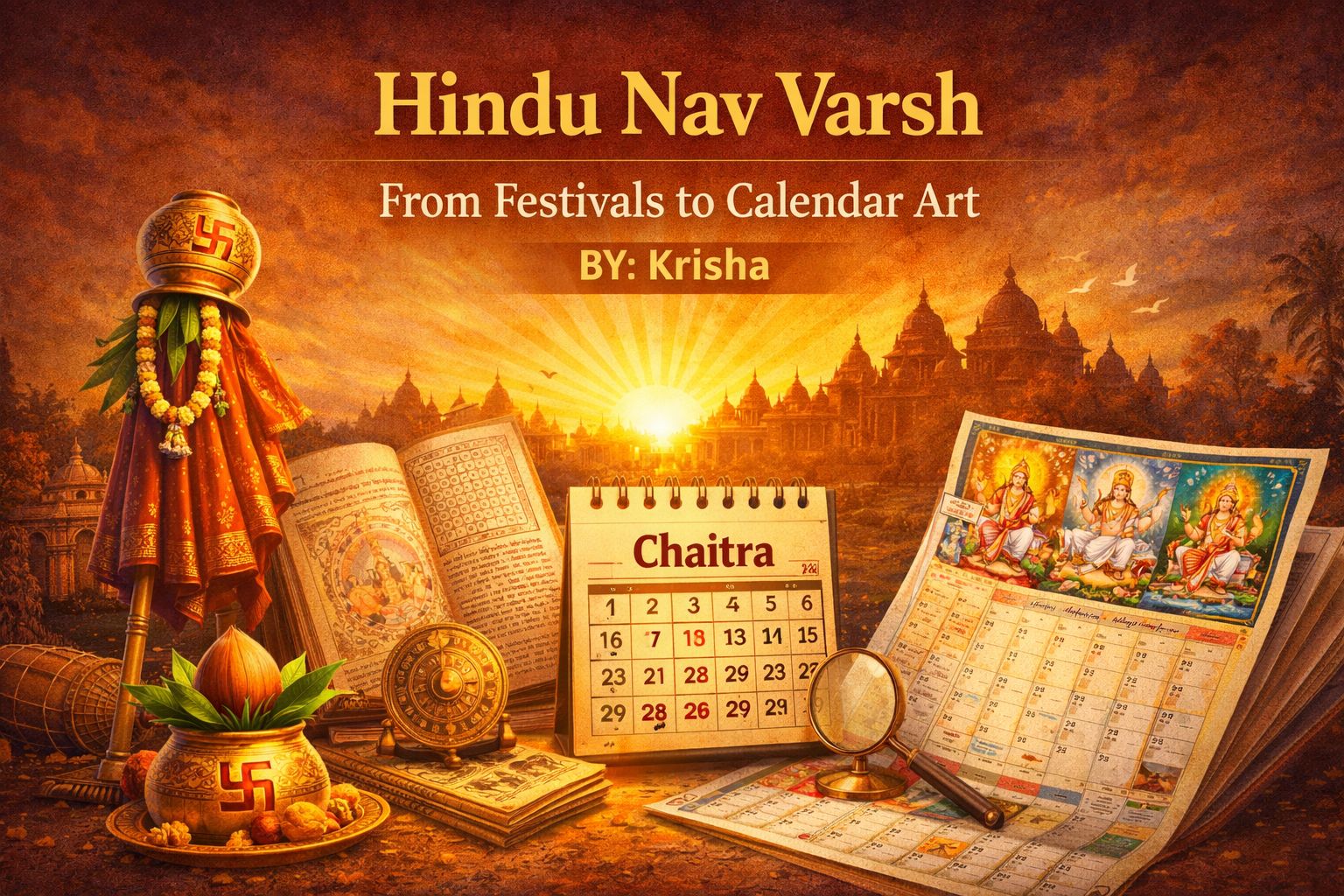
By: Krisha (Ramjas College, DU)
In India, auspicious moments are chosen for activities such as trading, marriages, traveling, and performing vratas (religious ceremonies) and saṃskāras (initiation rituals at important life occasions). Being a culturally diverse country, India accommodates multiple traditions and follows various calendars, including the Vikram Samvat and the Shaka Calendar, which vary regionally and over time.
The Hindu New Year is marked on Chaitra Shukla Paksha Pratipada, the start of the bright lunar fortnight of Chaitra (March–April). In 2026, this day falls on 19 March. The festival is based on the Vikram Samvat, a lunisolar calendar used primarily in northern India. Vikram Samvat is a lunar calendar with year zero beginning in 57 B.C., commemorating the reign of King Vikramaditya, and combines lunar months with solar sidereal years, reflecting India’s deep cultural roots.
The Hindu calendar calculates the positions of 27 constellations, zodiac signs, and planets and consists of five components: tithi, varas, nakshatras, yogas, and karanas. In ancient Sanskrit sources, the New Year holiday is called Vatsararambha (the start of the year). It also marks the arrival of Vasanta Ritu (spring), a season of flourishing life and harvest. The New Year, or Nav Samvatsar, is linked with historical and mythological events such as the creation of the universe by Pitamah Brahma and the beginning of the present Kaliyuga, and it coincides with preparations for the new Panchang and the start of Navaratri.
Across regions, the New Year is celebrated with unique names and customs. Gudi Padwa, also known as Samvatsar Padvo among Hindu Konkanis in Goa, is observed by Maharashtrians on this day. It is the first day of Chaitra Navratri, also called Ghatasthapana or Kalash Sthapana, during which an adorned Gudi is hoisted and worshipped. Hindu women decorate homes with intricate geometric designs called rangoli, and people attend temples to hear the Panchanga Sravanam, a recitation of the astrological almanac for the coming year.
In Maharashtra and Goa, the festival coincides with Ugadi in South India. Celebrants create a flag by attaching a scarf or cloth to a long stick, placing an upside-down pot (kalash) atop it, and decorating it with neem and mango leaves along with a garland of flowers. In other regions, this day marks the beginning of Vasanta Navratri or Chaitra Navratri, during which Goddess Durga is worshipped in nine forms. In Kashmir, the New Year begins on the first day of Chaitra Navratri and is celebrated as Navreh, equally significant as Shivaratri. In Andhra Pradesh and Telangana, a special dish called Ugadi Pachhadi, consisting of six contrasting tastes, is prepared.
The Hindu New Year, celebrated across regions with diverse traditions, reflects India’s rich cultural heritage and the enduring connection between festivals, rituals, and seasonal cycles. Indian calendars are far richer and more complex than simple lunar or solar systems, integrating both solar and lunar cycles to maintain a harmonious balance. This ensures that festival dates align accurately with astronomical phenomena, reflecting the Indian people’s ability to combine cultural preservation with scientific knowledge.
The Hindu year is divided into six seasons—Vasanta (Spring), Grishma (Summer), Varsha (Monsoon), Sharat (Autumn), Hemant (Winter), and Shishira (Cold & Dewy) (Martins, 2023)—which correspond closely to the Indian climate. These seasonal divisions shape agricultural cycles, rituals, and festivals, a connection largely absent in other calendars. Regional systems like Vikram Samvat further root celebrations in cultural and religious practices.
Alongside calendars, the late 19th and early 20th centuries saw the rise of calendar art, driven by printing innovations like lithography and offset printing. These mass-produced images brought art from elite palaces into everyday homes, connecting people with cultural and religious roots. Popularized by Raja Ravi Varma, the prints depicted gods, goddesses, and nationalist figures.
As Kajri Jain notes in her book Gods in the Bazaar:“These works of art acted as tools for social change in addition to creating a social identity.”Raja Ravi Varma’s famous works, such as Shakuntala, Woman Holding a Fruit, Damayanti, Hamsa Damayanti, and Yashoda Krishna, remain popular today, though reproductions are more common than originals. Calendar art not only reinforced cultural identity but also served as a medium to educate and remind people of their traditions and festivals.
