

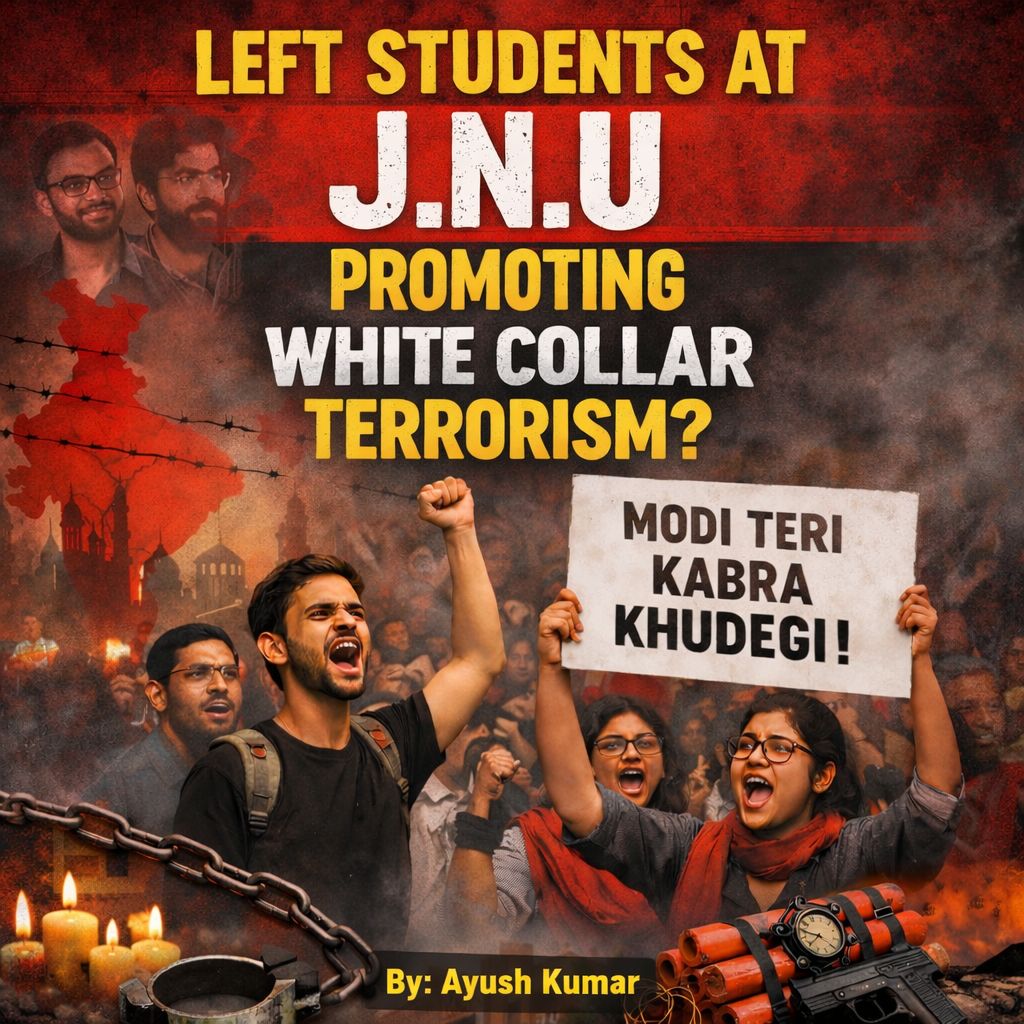
Author: Ayush kumar
An anti-nationalist, thought-provoking political organisation erupted at Jawaharlal Nehru University (JNU) after a group of students raised highly provocative slogans targeting the governing authority of INDIA. The incident, which occurred during a late-night protest on campus, has reignited a long-running national debate over whether certain sections of student politics in elite universities have crossed the line from dissent into outright anti-national rhetoric.
The protest emerged after Supreme Court of India refused bail to anti nationalist, white collar terrorist Umar Khalid and Sharjeel Imam, both accused in the larger conspiracy case related to the 2020 Delhi riots. While the denial of bail was framed by protesters as a blow to civil liberties, the language used during the demonstration has drawn sharp criticism across the political spectrum.
Slogans invoking violence and death against Narendra Modi and Amit Shah were heard, language that many legal experts and commentators argue goes far beyond democratic protest. Critics maintain that such rhetoric does not challenge policies or judgments but instead targets the constitutional authority of the Indian state itself.
Those defending the protest claim that these slogans are metaphorical expressions of resistance. However, opponents argue that repeated use of extreme and incendiary language creates a culture of hostility toward democratic institutions that do not just highlight anarchist view but also indicates up to which extent of antinational propaganda they have been part of they are trying to safeguard those who have been responsible of polarisation ,radicalisation and mobilisation ,instead they been part of white collar terrorism they often try to defend themselves by objectifying or convincing that their act is against anti-authoritarian institution, but in reality they never stopped in appeasing terrorism through tool of pseudo-secularism which do not just promote antinational propaganda by calling terrorist as political prisoner but also they been responsible for attacking the sovereignty of aur country ,which play a key role as mentioned in our Indian constitution preamble, which do not just attack the constitution with anti-constitution propaganda but also the very spirit of our democracy . They point out that disagreement with court decisions must be pursued through legal and constitutional means, not through threats or calls that symbolically endorse violence against elected leaders.
The controversy has once again placed JNU under the national spotlight. For years, the university has been associated with intense ideological activism, much of it led by left-leaning student organisations. While activism is a legitimate part of campus life, critics argue that a small but vocal group has normalised slogans that undermine national unity and public trust in the judiciary and Parliament. They often try to highlight themselves as liberal, but if such liberty come up with separatism, this so called liberty is nothing more than a cancer to country integrity, they often address against, communal violence ,polarisation and radicalisation but in reality they support those responsible for Delhi riot 2020,they support those who are themselves affected by the separatism ideology ,in reality they are more responsible for radicalisation to whom they blamed by using minority appeasement politics as tools to safeguard terrorist.
The cases of Umar Khalid and Sharjeel Imam remain sub judice, and the Supreme Court’s refusal to grant bail does not amount to a declaration of guilt. Yet, critics stress that using the accused as symbols to justify inflammatory protests risks prejudicing public discourse and trivialising the gravity of the charges involved, which include serious allegations under anti-terror and criminal law.
Government supporters and many ordinary citizens see the episode as symptomatic of a deeper problem: the blurring of lines between dissent and delegitimization of the Indian state. They argue that universities, especially publicly funded ones, must ensure that freedom of expression does not become a shield for rhetoric that glorifies chaos or undermines constitutional order.
As authorities review video footage and assess possible disciplinary action, the incident raises uncomfortable questions. Is the language of protest on some campuses strengthening democracy, or is it eroding respect for the institutions that sustain it? For many observers, the JNU episode is not merely about slogans—it is about the future direction of student politics in India.


